
What Is Living Documentation in Software?

Living documentation in software is defined as documentation that evolves continuously alongside the codebase, automatically updated through integration with tests, code, and models rather than maintained as a separate, static artifact. Unlike a PDF spec written at project kickoff and forgotten by sprint three, living documentation reflects the current state of the system at any given moment. It is extracted from code, tests, and models, automatically verifiable, and woven into development workflows. Tools like SmartBear's CucumberStudio, GitHub-hosted frameworks like LivingDocFramework, and spec-sync utilities like livespec represent the practical toolchain that makes this possible. For software teams dealing with documentation drift, onboarding delays, and cross-functional miscommunication, living documentation is the most direct solution available.
What is living documentation in software, and how does it work?
Living documentation is tied to automated test results or code updates, which means it stays current without requiring a dedicated documentation sprint. The core mechanism is coupling: documentation artifacts are generated from, or enforced alongside, the same source of truth that drives the software itself. When a test passes or a schema changes, the documentation reflects that change automatically or flags the discrepancy for resolution.
This approach treats documentation as a first-class output of the development process, not an afterthought. Design decisions, behavioral contracts, and system boundaries become visible through the documentation rather than buried in Slack threads or someone's personal notes. The result is a system where reading the docs gives you an accurate picture of what the software actually does today, not what someone intended six months ago.

Living documentation also supplements spec-driven development and domain-driven design. Where spec-driven development protects system contracts, living documentation preserves knowledge about what currently exists. Both practices reinforce each other, and teams that adopt one often benefit from adopting the other.
How does living documentation differ from traditional documentation?
Traditional documentation is static by nature. A Word document, a Confluence page, or a PDF spec captures the system as it was understood at the moment of writing. The moment the code changes, that document begins to drift. Documentation separated from software leads to rapid staleness, loss of credibility, and decreased team usage. Engineers stop reading docs they cannot trust, and they stop updating docs nobody reads.
The contrast with living documentation is structural, not just philosophical:
| Dimension | Traditional documentation | Living documentation |
|---|---|---|
| Update mechanism | Manual, scheduled, or ad hoc | Automated or enforced at commit time |
| Source of truth | Separate document or wiki | Code, tests, and models |
| Accuracy over time | Degrades rapidly | Maintained through automation |
| Team trust | Erodes as drift accumulates | High, because docs are verifiable |
| Onboarding value | Unreliable after first release | Consistently accurate for new hires |
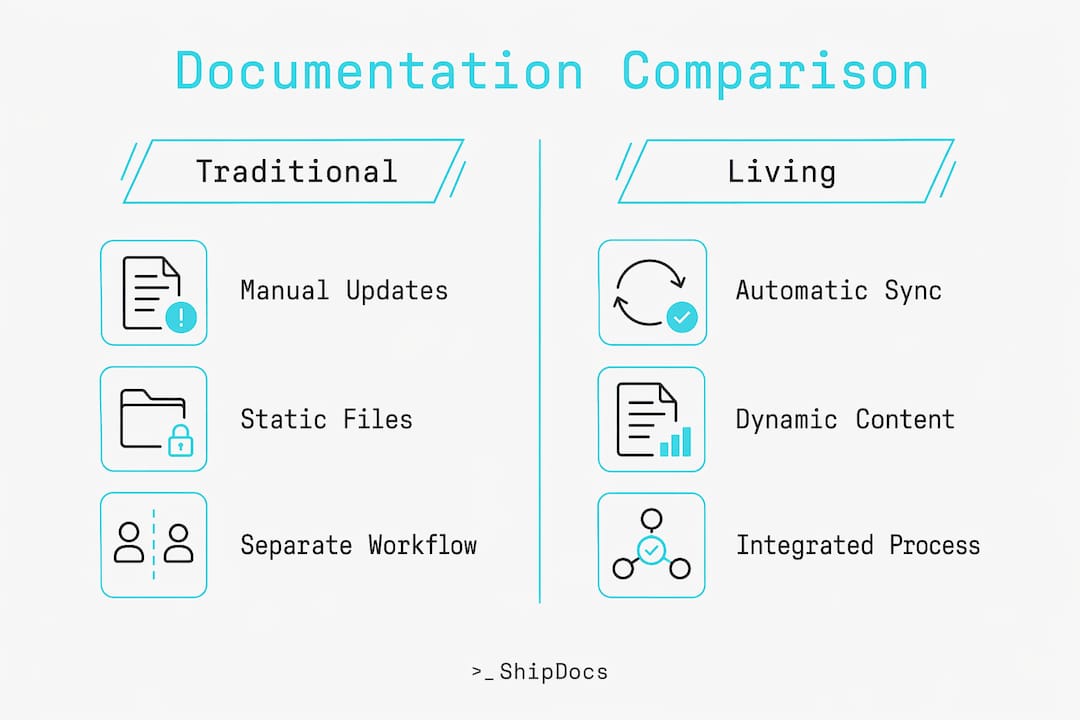
The practical risk of stale documentation goes beyond inconvenience. Stale documentation can be worse than no documentation because it produces confident wrong assumptions. A developer who reads an outdated API spec and builds against it has wasted hours, or days, before discovering the mismatch. Living documentation eliminates that failure mode by keeping the reference accurate.
Key differences that matter most for teams making the switch:
- Living docs integrate into CI/CD pipelines, so documentation accuracy is a byproduct of the build process.
- Traditional docs require a human to remember to update them, which rarely happens under deadline pressure.
- Living docs make behavioral contracts visible and testable, not just described.
- Traditional docs often lack version history tied to code changes, making it hard to understand why a decision was made.
What are common living documentation examples and tools?
The most widely cited living documentation examples come from behavior-driven development (BDD) workflows. SmartBear's CucumberStudio generates and syncs living documentation from BDD test runs, organizing features and scenarios with full history tracking. Every time a test suite runs in CI/CD, the documentation reflects the latest feature definitions. This is living documentation at its most automated: no human intervention required between a code change and an updated doc.
Beyond BDD, several other patterns and tools are worth knowing:
- LivingDocFramework uses Git pre-commit hooks to enforce documentation updates, blocking commits when documentation is outdated. This shifts the enforcement point to the moment of code change rather than relying on post-hoc updates.
- livespec links specs to tests and provides commands to detect drift, using tags like "@spec` to keep narrative specifications aligned with executable tests. When the spec and the test diverge, the tool surfaces the discrepancy immediately.
- OpenAPI and AsyncAPI schemas serve as living documentation for REST and event-driven APIs. Generating API reference docs from machine-readable schemas dramatically reduces staleness because the documentation is derived directly from the contract the code enforces.
- CI/CD pipeline artifacts such as test reports, coverage summaries, and deployment logs function as living documentation when structured and published consistently.
Pro Tip: Treat your most change-prone documents, specifically API references and BDD scenarios, as the first candidates for automation. These are the docs that drift fastest and cause the most damage when wrong. Automate them first, then extend the practice to other artifact types.
What are the benefits of adopting living documentation?
The benefits of living documentation are concrete and measurable across four dimensions that matter to engineering teams.
-
Accuracy and reduced drift. Because documentation is generated from or enforced alongside code, the gap between what the system does and what the docs say closes automatically. Teams using automated doc generation from schemas report fewer integration errors caused by outdated references.
-
Faster onboarding. New engineers can read documentation and trust it. When docs reflect the actual codebase, a developer joining the team can onboard in a fraction of the time compared to teams where documentation is unreliable. They spend time building, not reverse-engineering the system from source code.
-
Improved cross-functional communication. Shared living documentation gives business and technical teams one source of truth. Product managers, QA engineers, and developers all read the same artifact, which reduces misunderstandings about what a feature does or should do.
-
Knowledge preservation. When design decisions are recorded in documentation that stays current, institutional knowledge does not walk out the door when a senior engineer leaves. The system's history and rationale remain accessible.
"Documentation that lies is more dangerous than no documentation at all. Living documentation removes the lie by making accuracy a structural property of the system, not a personal responsibility."
Living documentation in agile environments is particularly effective because agile teams change requirements frequently. Static docs become liabilities in agile; living docs become assets.
How can teams implement living documentation effectively?
Effective implementation requires thinking about the full documentation lifecycle, not just where documents are stored. The most common failure mode is treating living documentation as a tooling problem when it is equally a cultural and workflow problem. The success of living documentation relies on cultural practices that enforce updating during development, not after.
Here is a practical implementation path:
- Step 1: Identify drift-prone artifacts. Start with API references, BDD scenarios, and integration contracts. These change frequently and cause the most damage when stale.
- Step 2: Automate generation for reference docs. Use OpenAPI, AsyncAPI, or similar schema-driven tools to generate API documentation directly from code. This eliminates manual updates for the highest-risk category.
- Step 3: Enforce documentation at commit time. Implement Git pre-commit hooks using a framework like LivingDocFramework to block commits when documentation is missing or outdated. This makes documentation a condition of code acceptance, not an optional extra.
- Step 4: Link narrative specs to executable tests. Use a tool like livespec to tag specifications with
@specmarkers and run drift detection commands as part of your CI pipeline. Silent divergence between specs and tests is one of the hardest problems to catch manually. - Step 5: Balance generated docs with human-written narratives. Automated reference docs cover the "what." Human-written guides cover the "why" and "how." Both are necessary. Do not let automation replace architectural decision records or onboarding guides.
Pro Tip: Use readme templates as a starting point for human-written narrative sections. A well-structured readme template gives teams a consistent format that is easier to maintain and update than freeform documents.
The best practices for living documentation converge on one principle: documentation must be a byproduct of the development process, not a separate workstream. When updating docs feels like extra work, it does not get done. When it is enforced by the toolchain, it happens automatically.
Key takeaways
Living documentation works because it couples documentation accuracy to the development process itself, making drift a structural impossibility rather than a discipline problem.
| Point | Details |
|---|---|
| Definition is structural | Living documentation is generated from or enforced alongside code, tests, and models, not written separately. |
| Stale docs cause real damage | Outdated documentation produces confident wrong assumptions, which cost more to fix than missing docs. |
| Automate the highest-risk docs first | API references and BDD scenarios drift fastest; automate these before tackling narrative guides. |
| Enforcement beats reminders | Git pre-commit hooks and CI pipeline checks make documentation updates mandatory, not optional. |
| Balance automation with narrative | Generated reference docs cover accuracy; human-written guides cover context, rationale, and onboarding. |
The case for treating documentation as a system property
At ShipDocs, we have seen the same pattern repeat across teams of every size. Documentation starts strong, then degrades the moment the team hits a deadline. The instinct is to blame discipline or process, but the real issue is architecture. When documentation lives outside the system, it decays like any other artifact that lacks a maintenance owner.
What changed our thinking was watching teams adopt commit-time enforcement. The moment documentation became a condition of merging code, the culture shifted. Engineers stopped treating docs as optional. They started writing them the way they write tests: as part of the definition of done. That cultural shift does not happen from a Confluence template or a documentation sprint. It happens when the toolchain makes the right behavior the path of least resistance.
We are also direct about one thing that most articles on this topic avoid: living documentation does not eliminate the need for human judgment. Automated generation handles accuracy. It does not handle clarity, context, or the kind of architectural narrative that helps a new engineer understand why the system is built the way it is. The teams that get the most value from living documentation are the ones that automate aggressively and write deliberately. They know which parts of their docs need a machine and which parts need a person.
The connection to domain-driven design is worth noting for teams working in that space. Living documentation makes bounded contexts and aggregate boundaries visible in a way that static diagrams cannot. When the documentation reflects the actual code, the domain model stays honest.
— ShipDocs
How ShipDocs helps teams build living documentation
ShipDocs is built for teams that need documentation to stay current without adding manual overhead to every sprint.
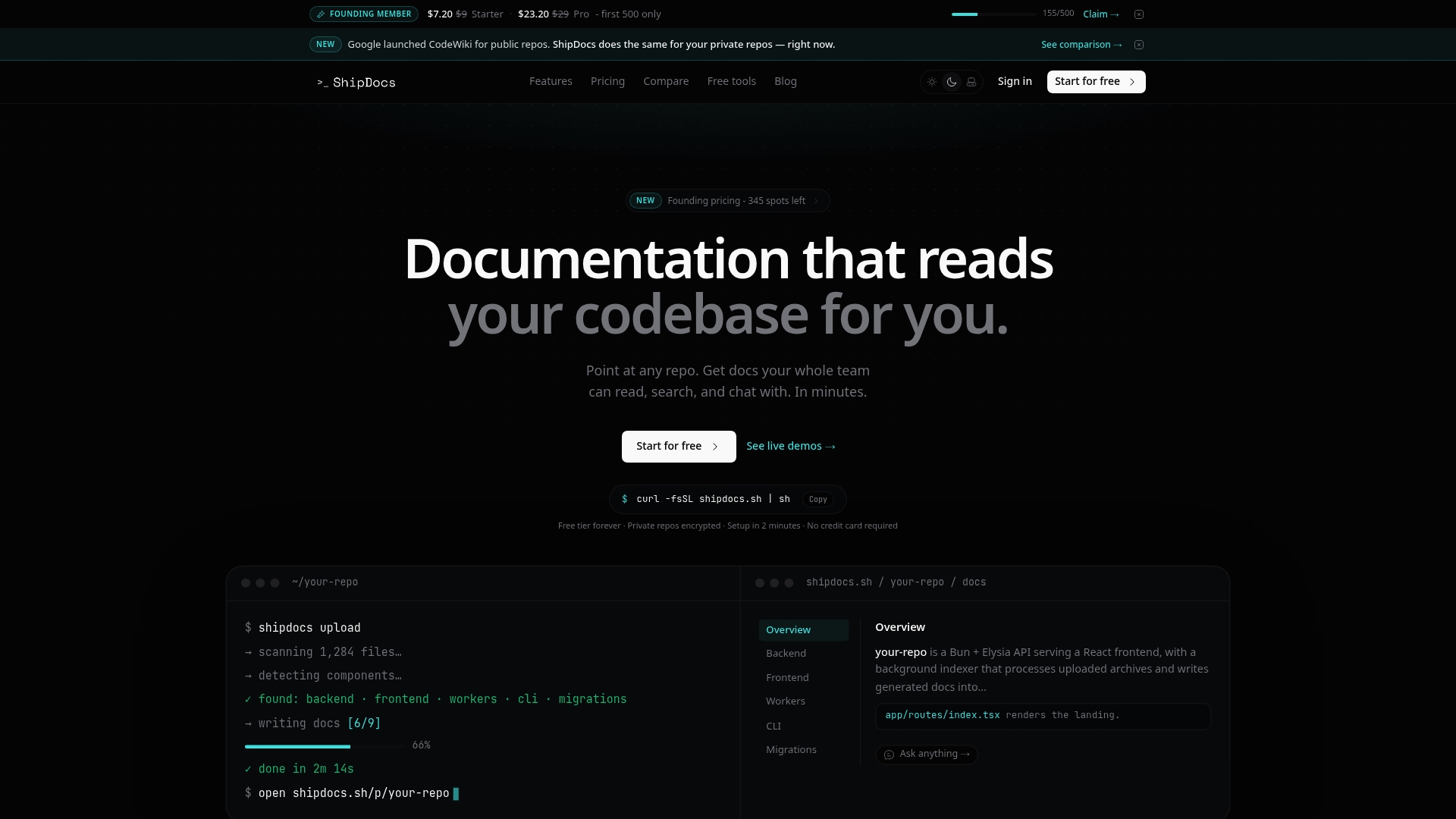
ShipDocs connects directly to private repositories and generates comprehensive documentation automatically, averaging just over two minutes per run. The AI-powered codebase chat answers questions with exact file references, so engineers and non-technical stakeholders get accurate answers without digging through outdated wikis. For teams scaling fast or dealing with high onboarding costs, ShipDocs makes the codebase immediately accessible. Explore the full documentation toolset to see how automation and AI-driven interaction work together to keep your docs aligned with your code.
FAQ
What is living documentation in software development?
Living documentation is documentation that updates automatically or is enforced to update alongside code changes, keeping it accurate and aligned with the current state of the system. It is typically generated from tests, code, or machine-readable schemas rather than written and maintained separately.
How does living documentation differ from a wiki or Confluence page?
A wiki or Confluence page is a static artifact that requires manual updates and quickly becomes outdated as the codebase changes. Living documentation is coupled to the development workflow, updated through automation or enforced at commit time, so it reflects the actual system rather than a historical snapshot.
What tools support living documentation?
SmartBear's CucumberStudio generates living documentation from BDD test runs, LivingDocFramework enforces documentation updates via Git pre-commit hooks, and livespec links narrative specs to executable tests with automated drift detection. OpenAPI and AsyncAPI schemas also serve as living documentation for API references.
Is living documentation only relevant for agile teams?
Living documentation is most commonly discussed in agile contexts because agile teams change requirements frequently, making static docs a liability. The underlying principles apply to any team where documentation accuracy matters, regardless of methodology.
How do you prevent living documentation from becoming outdated?
Automating the most change-prone documents and enforcing documentation updates at commit time are the two most reliable prevention strategies. Linking executable specs to tests with drift detection commands, as livespec does, catches silent divergence before it reaches production.
Recommended
- ShipDocs — The CodeWiki Alternative With Private Repo Support | AI Docs & Codebase Chat
- ShipDocs — The CodeWiki Alternative With Private Repo Support | AI Docs & Codebase Chat
- ShipDocs — The CodeWiki Alternative With Private Repo Support | AI Docs & Codebase Chat
- ShipDocs — The CodeWiki Alternative With Private Repo Support | AI Docs & Codebase Chat